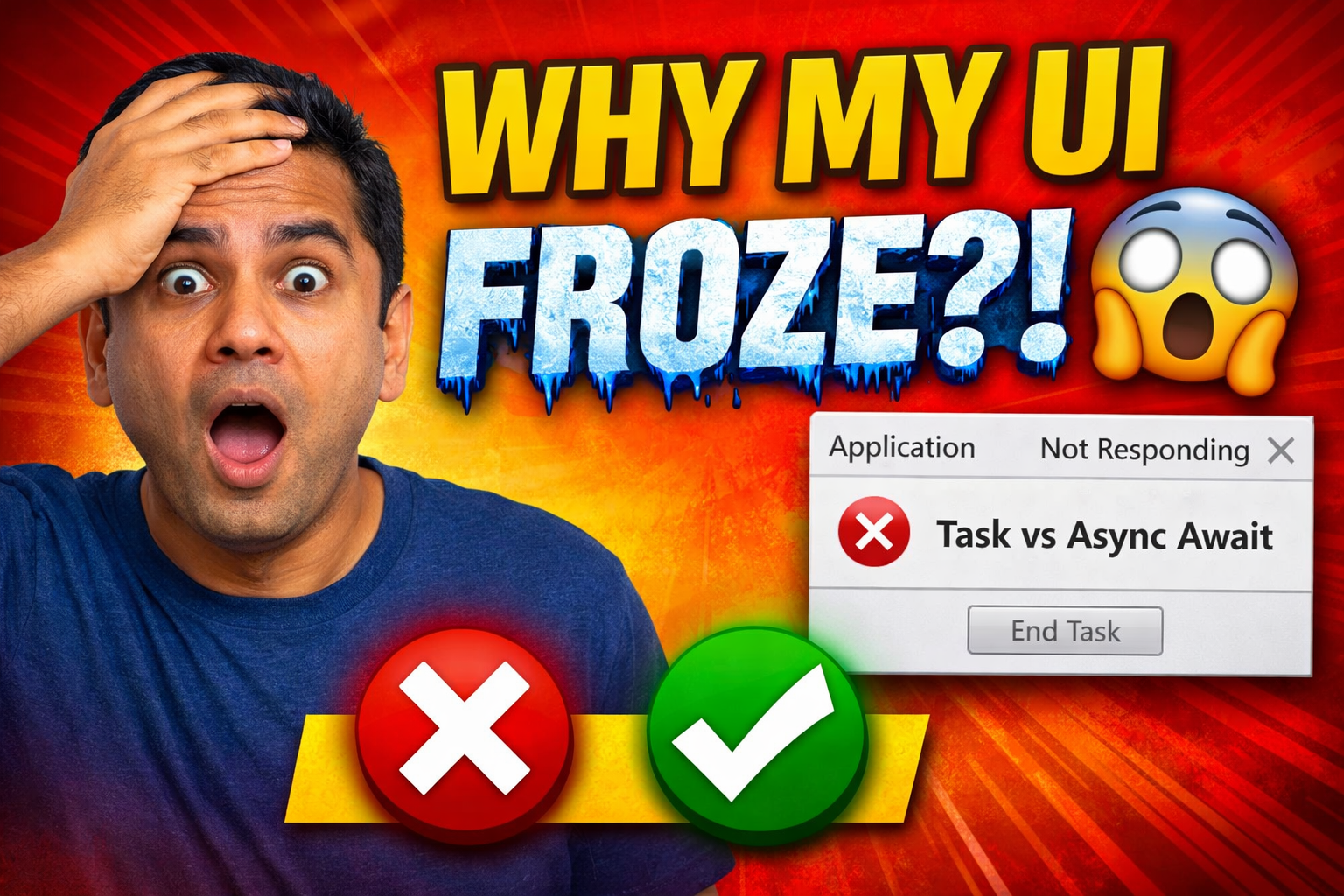
One of the most common confusions in C# asynchronous programming is the difference between
Task and async / await.
Many developers assume that the moment they use a Task, their code becomes asynchronous.
Unfortunately, this misunderstanding is the root cause of many
UI freezing, deadlocks, and poor application responsiveness.
In this blog, I will explain this concept using a real WinForms example, exactly the way I explain it to my 1-to-1 students. No theory overload — only fundamentals and behavior.
Consider a CPU-intensive operation such as finding the N-th prime number. This is intentionally a heavy calculation so that the effect on the UI is clearly visible.
In a WinForms application, all button clicks and UI updates happen on the main UI thread. If we execute a long-running method directly on this thread, the UI becomes unresponsive.
This is exactly what happens in the synchronous version of the code.
static long FindNthPrime(int n)
{
    int count = 0;
    long number = 1;

    while (count < n)
    {
        number++;
        if (IsPrime(number))
        {
            count++;
        }
    }
    return number;
}

private void btnFindPrime_Click(object sender, EventArgs e)
{
    var res = FindNthPrime(int.Parse(tbNum.Text));
    label1.Text = "Result is " + res;
}
Here, FindNthPrime runs on the UI thread itself.
While the calculation is running, the message pump cannot process repaint or input events.
As a result, Windows marks the application as Not Responding.
Many developers then try to fix the problem by introducing a Task.
This is where the real misunderstanding starts.
A Task represents a unit of work — not non-blocking behavior.
You can still block the UI thread even when using a Task.
Task<long> t = new Task<long>(() =>
{
    return FindNthPrime(int.Parse(tbNum.Text));
});

t.Start();

// This will BLOCK the UI thread
long res = t.Result;
label1.Text = "Result is " + res;
The problem here is t.Result.
This is a blocking wait.
The UI thread stops and waits until the Task completes.
So yes — the work runs on a background thread, but the UI thread is still blocked waiting for the result.
This is where async and await come into play. They do not create threads. They do not create Tasks.
Their only job is to say:
“When this Task finishes, resume execution without blocking the current thread.”
private async void btnFindPrimeAsync_Click(object sender, EventArgs e)
{
    Task<long> t = new Task<long>(() =>
    {
        return FindNthPrime(int.Parse(tbNum.Text));
    });

    t.Start();

    var res = await t;
    label1.Text = "Result is " + res;
}
When the compiler sees await, it splits the method into two parts.
The UI thread is released immediately.
When the Task completes, execution continues on the UI thread automatically.
This is why the label update works safely without any explicit thread handling.
A better design is to separate UI logic from computation logic. This also improves testability and reuse.
public Task<long> FindNthPrimeAsync(int num)
{
    Task<long> t = new Task<long>(() =>
    {
        return FindNthPrime(num);
    });

    t.Start();
    return t;
}

private async void btnFindPrimeAsync2_Click(object sender, EventArgs e)
{
    var res = await FindNthPrimeAsync(int.Parse(tbNum.Text));
    label1.Text = "Result is " + res;
}
Notice something important:
FindNthPrimeAsync does not use async at all.
It simply returns a Task.
The await is applied at the consumption point — exactly where non-blocking behavior is required.
Because they solve different problems.
Using a Task does not automatically make your code non-blocking.
Using await incorrectly (or not at all) defeats the entire purpose.
This distinction is extremely important for interviews and real-world applications.
I explain this concept step-by-step with live execution and UI behavior in my YouTube video:
👉 Task vs Async Await in C# – Real WinForms Demo
Task is not async by default.
await is what prevents thread blocking.
Once this concept is clear, asynchronous programming in C# becomes logical, predictable, and interview-safe.
If you want structured, fundamentals-first 1-to-1 training in C# and .NET, feel free to reach out via my website.
To keep every session productive and distraction-free, please follow these simple guidelines:
Following these guidelines helps you focus better and ensures I can deliver the best learning experience in every class.
I prefer to start with a short 10-minute free call so I can understand:
Why? Because course content, teaching pace, and fees all depend on your needs — there’s no “one-size-fits-all” pricing. Please leave your details below, and I’ll get back to you to arrange a convenient time for the call.
Note: Payment is made only after your first class or after a long telephonic conversation, once you’re completely satisfied. However, fees once paid is non-refundable. This helps maintain scheduling commitments and allows me to reserve your preferred time slot with full attention.
We would like to extend our sincere gratitude and appreciation to Mr. Sudipto of Supernova Services for a tremendous professionalism, for his unique ability in sharing and teaching technical concepts to us! The abundance and wealth of knowledge we have received during the last few years will never be forgotten. He is a superb mentor, really knows how to approach any topic and present it in such way to ensure his student’s full understanding. He really cares about his students, as I have witnessed firsthand, Mr. Sudipto very often went above and beyond the call of duty to assist. He is a great person, very passionate about technologies, with unique talents and ability to teach spanning many different topics and technologies! I wish we could rank his services higher than available 5 stars here, perhaps 50 stars. Mr. Sudipto and Supernova Services, you are the BEST! Thank you for everything!!!
Boris Olshansky

It was an awesome experience for me in improving, especially my technical skills to a new paradigm, I learned and benefited immensely from the course and Sudipto Sir. The course design is meticulously well planned, very updated, utmost industry oriented, International standard, .... and after all Sudipto Sir is superb .... extremely knowledgeable .... student friendly .... very easily he make someone understand with very own our real life examples .... I have been immensely benefited during my career with TCS ....
Siddhartha Mohanty

I had a great time doing this course and everyone involved in the SUPERNOVA has made it a great experience. I have been recommending everyone I know. Thank you for all the assistance and feedback, it has been delightful.
Avijit Chakraborty

Very easy to understand...Explanation is very good...Really enjoyed this course and learned lot of things from scratch..The tutor is obviously extremely skilled by going through this course we can have the ability to develop our own application...
Thanks to SUPERNOVA SERVICES
Priyesh Joseph

Best Dot Net mentor..... learned a lot and gain an immense knowledge from him..... the way he teaches everyone is really outstanding.... 🙂🙂
Sayantani Mandal

Mr. Sudipto Mukherjee is one of the best instructors I have ever come across. His way of training is nothing short of art. He will teach you why you need or not need to write a piece of code rather than just saying that it should be done, and that makes coding enjoyable and the code very performance oriented. If you want to really learn, you have to really become his friend... He will then take you to the deep end. I am saying this from personal experience.... Just one thing... He does not come cheap, but you get much more than what you have paid for.
Sampat Das

Excellent tutor! Let's just say that as a bio-math student, I had next to no experience at coding. A few classes with Mr.Sudipto, and bam! His teaching methods are extremely student-friendly and interactive - The classes are never monotonous, and every new task he presented was an interesting one to look forward to. Within no time, I could write programs of my own. Definite recommend!! 👍🏻
Juhi
