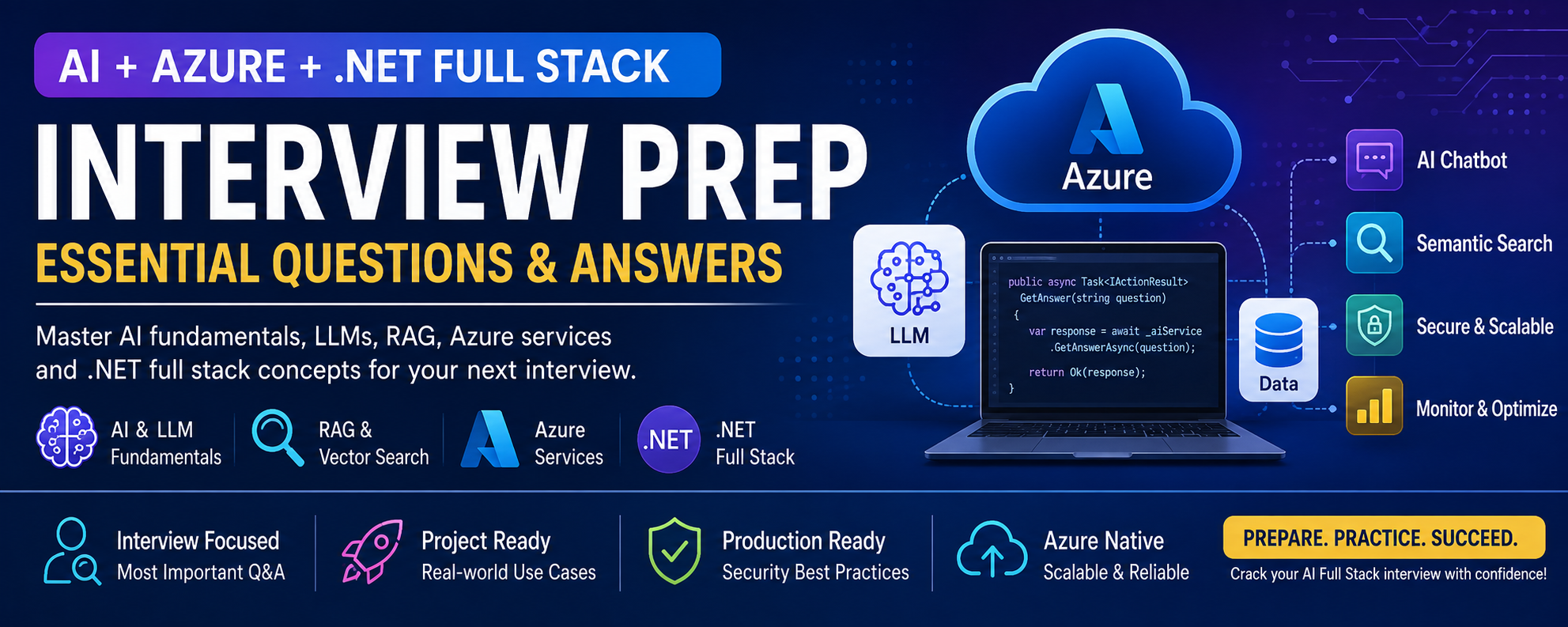
If you are a .NET developer preparing for an AI Full-Stack interview, you do not necessarily need to become an AI researcher.
What you do need is a clear understanding of the basic AI concepts, how an LLM works at a high level, how RAG works, and how these technologies fit into a normal full-stack application.
You should also be comfortable explaining the main Azure services used to build, deploy, secure and monitor an AI application.
This guide covers the questions and concepts that are useful for a .NET developer preparing for an AI and Azure Full-Stack interview.
Artificial Intelligence, or AI, is the broad field of making computers perform tasks that normally require human intelligence.
Examples include:
Machine Learning is a part of AI where a system learns patterns from data instead of being given every rule by a programmer.
For example, instead of writing rules to identify spam emails, we can train a model using many examples of spam and non-spam emails.
Deep Learning is a part of Machine Learning that uses neural networks with many layers.
Deep learning is used in areas such as:
A neural network is a mathematical model made of connected layers of units commonly called neurons.
During training, the model adjusts numerical parameters called weights so that its predictions become better.
Generative AI refers to AI systems that can generate new content.
For example:
LLM stands for Large Language Model.
An LLM is a deep-learning model trained on large amounts of text and code so that it can understand and generate language.
Yes.
An LLM is a Machine Learning model. More specifically, modern LLMs are deep neural-network models and commonly use the Transformer architecture.
A simple way to remember the relationship is:
AI → Machine Learning → Deep Learning → Neural Networks → Transformer architecture → LLM
A model is the learned mathematical representation produced through training. An application sends input to the model and receives an output.
Training is the process of adjusting a model's parameters using data so that its predictions become better.
Inference is using an already-trained model to produce an output for a new input.
The model learns from examples where the expected answer is already known.
The model looks for patterns in data without being given a target answer for each example.
A system learns by taking actions and receiving rewards or penalties.
A token is a small piece of text processed by an LLM. A word may be one token or several tokens.
Tokens affect context size, cost, latency, and how much information can be sent to a model.
A prompt is the input or instruction given to an AI model.
It is an instruction that sets the model's role, rules, and general behavior.
It is the user's actual request or question.
Context is additional information supplied to the model so it can produce a more useful answer.
It is the amount of input and output information a model can handle in one interaction, measured in tokens.
Temperature controls how varied the model's output can be. Lower values are usually more focused; higher values can be more varied.
A hallucination is an answer that sounds convincing but is incorrect or unsupported by reliable information.
No. An LLM should not be treated as a source of truth. Important information should be grounded in trusted data or checked by application logic.
Prompt engineering means designing clear instructions and context so that a model produces a useful and consistent result.
A foundation model is a large general-purpose model trained on broad data that can be adapted for many tasks.
An embedding is a numerical vector that represents the meaning or features of data, such as text.
They allow applications to compare the semantic similarity between pieces of information.
For example:
"How do I reset my password?"
and
"How can I change my password?"
have different words but very similar meanings.
Vector search finds items whose embeddings are close to the embedding of the user's query.
Semantic search tries to understand the meaning of a query instead of relying only on exact keyword matches.
Keyword search mainly looks for matching words or terms in indexed data.
Hybrid search combines keyword search and vector search. It can also use semantic ranking to improve the final results.
It helps an application find relevant information even when the user's wording is different from the wording in the source documents.
RAG means Retrieval-Augmented Generation. The application retrieves relevant information and gives that information to the LLM as context before generating an answer.
RAG allows an application to use private, current, or company-specific information without retraining the model for every document change.
User question → Retrieve relevant content → Add the content to the prompt → Call the LLM → Return the answer.
Chunking means splitting a large document into smaller pieces so that relevant pieces can be retrieved efficiently.
A large document may waste tokens, increase cost and latency, and may contain a lot of irrelevant information.
Instead, a RAG system retrieves only the relevant sections.
An index stores searchable information about documents or chunks so that relevant content can be found quickly.
RAG supplies external information at query time.
Fine-tuning changes or adapts the model's learned behavior by training it on additional examples.
A simple way to remember it:
RAG gives the model additional knowledge at runtime.
Fine-tuning adapts the model's behavior through additional training.
No. RAG can reduce hallucinations by grounding answers in retrieved information, but the application still needs good retrieval, prompts, validation, and monitoring.
Citations show which source document or section was used to support an answer. They improve trust and make the answer easier to verify.
An AI agent is an application that can use a model together with tools, instructions, and sometimes memory to complete a task.
A simple chatbot mainly generates responses. An agent can decide to call tools or services and use their results before producing a response.
It is a mechanism where the model requests that the application call a defined function or tool, such as GetOrder() or SearchCustomer().
No. The application controls execution. The model can request a tool call, and the application decides whether and how to execute it.
A support agent could receive a customer's question, call an order API, search the return policy, and then explain whether the order can be returned.
No. Authentication and authorization must be enforced by the application and identity system. The LLM is not a security boundary.
Microsoft Foundry is Microsoft's Azure platform for building and operating AI applications.
It brings together capabilities around:
Azure OpenAI provides access to OpenAI models through Microsoft's Azure platform.
It allows developers to integrate language and other AI capabilities into applications while using Azure's enterprise infrastructure and security features.
Azure AI Search is a managed search service.
It supports:
It is commonly used as the retrieval component in RAG applications.
Azure App Service is a managed platform for hosting web applications and APIs without managing the underlying servers.
Azure SQL Database is Microsoft's managed cloud relational database service based on SQL Server.
Blob Storage is used to store objects such as documents, images, videos, backups, and other files.
Azure Functions is a serverless service for running code in response to events or HTTP requests.
Key Vault securely stores secrets, keys, and certificates so that applications do not need to keep sensitive values in source code.
Microsoft Entra ID is Microsoft's cloud identity and access management service. It is commonly used for authentication and access control.
Application Insights is an Azure monitoring service used to collect telemetry about application requests, dependencies, exceptions, performance, and other behavior.
A resource group is a logical container for related Azure resources.
An Azure subscription is a billing and management boundary for Azure resources.
Managed Identity gives an Azure resource an identity that can be used to access other Azure resources without storing a password or API key in the application.
It reduces the need to store long-lived credentials and works with Microsoft Entra ID and Azure role-based access control.
RBAC means Role-Based Access Control. Permissions are assigned through roles instead of giving every user or application unrestricted access.
They should be kept in a secure service such as Azure Key Vault, not in source code or a public repository.
Authentication answers:
"Who are you?"
Authorization answers:
"What are you allowed to do?"
401 usually means the caller is not properly authenticated.
403 means the caller is authenticated but does not have permission for the resource.
Give a user or application only the permissions it actually needs, and no more.
ASP.NET Core is well suited for building secure APIs, business logic, authentication, database access, and integrations with AI services.
Dependency Injection provides required services to a class instead of making the class create those services itself.
It reduces coupling and improves testing.
builder.Services.AddScoped;Transient: Creates a new instance when requested.
Scoped: Normally creates one instance per HTTP request.
Singleton: Creates one instance for the application's lifetime.
Middleware is a component in the ASP.NET Core request pipeline.
It can inspect, modify, or handle HTTP requests and responses.
They are particularly useful for I/O-bound operations such as database calls, HTTP calls, file operations, and AI service calls.
They allow the application to avoid blocking a thread while waiting for the operation to complete.
A REST API exposes resources through HTTP and commonly uses:
EF Core is an object-relational mapper for .NET.
It lets developers work with database data using .NET objects and LINQ.
DbContext represents a session with the database and manages querying, tracking, and saving entities.
Tracking lets EF Core keep information about loaded entities so it can detect changes and save them.
For read-only queries where change tracking is not required. It can reduce tracking overhead.
IEnumerable works with objects already available to the application.
IQueryable can build a query that is translated and executed by the data source, such as SQL Server.
A typical architecture could be:
Frontend → ASP.NET Core API → Azure AI Search → Azure-hosted language model → Answer
Documents can be stored in Azure Blob Storage.
Security can use Microsoft Entra ID, Managed Identity, RBAC, and Key Vault.
The application can be deployed to Azure App Service.
Application Insights can be used for monitoring.
Azure Blob Storage is a common choice.
Azure AI Search can store the searchable index, including text and vector information.
Azure SQL Database or another suitable relational database can be used.
Use:
Keep prompts focused and retrieve only relevant information.
Other techniques include:
First find where the time is being spent.
Check database calls, search, network calls, model response time, token counts, and unnecessary sequential operations.
The application should fail gracefully.
It should provide a useful message to the user, log the failure, and use appropriate retry or fallback strategies where required.
Prompt injection is an attempt to manipulate an AI system through input that tries to override or interfere with its intended instructions.
Data leakage is the accidental exposure of confidential or private information to an unauthorized person or system.
Grounding gives the model trusted information to use when answering. This can improve accuracy and reduce unsupported answers.
A model can make mistakes. Important outputs should be checked by application rules or a human when the risk is high.
Log useful operational information such as request IDs, latency, failures, model usage, and retrieval information while avoiding unnecessary sensitive data.
Do not casually log passwords, API keys, tokens, personal data, confidential documents, or full sensitive prompts and responses.
The application receives the question, retrieves relevant document content, sends the question plus retrieved context to the model, receives the generated answer, and returns it through the API.
Check document extraction, chunking, embeddings, search results, filters, ranking, prompt construction, context length, and the model response.
Revoke or rotate the exposed key immediately, remove it from the active configuration and repository, move the secret to a secure store, and check logs for possible misuse.
Measure each step: API processing, database calls, search, model call, network time, token counts, and retries.
Then optimize the actual bottleneck.
The application should enforce authorization and data access rules before returning information.
The model must not be trusted to make that security decision.
The query may be unclear, chunks may be badly created, embeddings may be poor for the data, filters may be wrong, or the search configuration may not match the question.
For many interviews, this architecture is a useful starting point:
User
↓
React / Blazor / Angular
↓
ASP.NET Core Web API
↓
Business Logic
↓
Azure AI Search + Azure-hosted AI Model
↓
Answer
Documents:
Azure Blob Storage
Database:
Azure SQL Database
Security:
Microsoft Entra ID
Managed Identity
RBAC
Key Vault
Hosting:
Azure App Service
Monitoring:
Application Insights
Important: The LLM generates language, but the application remains responsible for authentication, authorization, business rules, data access, and tool execution.
A strong project explanation can follow this structure:
"I built a full-stack AI application where users interact through a web frontend. The frontend calls an ASP.NET Core API. For company-specific questions, the API uses a retrieval layer to find relevant documents and sends that context to an Azure-hosted language model. Documents are stored in Blob Storage and indexed for search. The application uses Entra ID for identity, Managed Identity for secure Azure service access, Key Vault for secrets, and Application Insights for monitoring. The important point is that the AI model generates the response, but the application controls authentication, authorization, data access and tool execution."
Do not memorize this word for word.
Understand the architecture and explain it naturally.
AI: Broad field of intelligent computer systems.
Machine Learning: Systems learn patterns from data.
Deep Learning: Machine Learning using deep neural networks.
LLM: Large deep-learning model for language.
Generative AI: AI that generates new content.
Token: A unit of text processed by a language model.
Embedding: Numerical representation of meaning or features.
Vector Search: Search based on vector similarity.
RAG: Retrieve information and give it to the model as context.
Fine-Tuning: Further training a model to adapt its behavior.
Hallucination: A plausible-looking but incorrect AI answer.
Agent: AI application that can use tools to complete tasks.
Tool Calling: A model requests that an application call a defined function.
Microsoft Foundry: Microsoft's Azure platform for AI application development, models, agents, tools, evaluation and monitoring.
Azure AI Search: Managed search service supporting keyword, vector and hybrid search.
App Service: Managed Azure hosting for web applications and APIs.
Blob Storage: Azure storage for files and other objects.
Azure SQL: Managed relational database service.
Key Vault: Secure storage for secrets, keys and certificates.
Entra ID: Identity and access management.
Managed Identity: Azure-managed identity for secure service-to-service access.
RBAC: Role-Based Access Control.
Application Insights: Application monitoring and telemetry.
RAG + Azure AI Search + an Azure-hosted language model + ASP.NET Core is a very common architecture to understand when preparing for an AI Full-Stack .NET interview.
To keep every session productive and distraction-free, please follow these simple guidelines:
Following these guidelines helps you focus better and ensures I can deliver the best learning experience in every class.
I prefer to start with a short 10-minute free call so I can understand:
Why? Because course content, teaching pace, and fees all depend on your needs — there’s no “one-size-fits-all” pricing. Please leave your details below, and I’ll get back to you to arrange a convenient time for the call.
Note: Payment is made only after your first class or after a long telephonic conversation, once you’re completely satisfied. However, fees once paid is non-refundable. This helps maintain scheduling commitments and allows me to reserve your preferred time slot with full attention.
We would like to extend our sincere gratitude and appreciation to Mr. Sudipto of Supernova Services for a tremendous professionalism, for his unique ability in sharing and teaching technical concepts to us! The abundance and wealth of knowledge we have received during the last few years will never be forgotten. He is a superb mentor, really knows how to approach any topic and present it in such way to ensure his student’s full understanding. He really cares about his students, as I have witnessed firsthand, Mr. Sudipto very often went above and beyond the call of duty to assist. He is a great person, very passionate about technologies, with unique talents and ability to teach spanning many different topics and technologies! I wish we could rank his services higher than available 5 stars here, perhaps 50 stars. Mr. Sudipto and Supernova Services, you are the BEST! Thank you for everything!!!
Boris Olshansky

It was an awesome experience for me in improving, especially my technical skills to a new paradigm, I learned and benefited immensely from the course and Sudipto Sir. The course design is meticulously well planned, very updated, utmost industry oriented, International standard, .... and after all Sudipto Sir is superb .... extremely knowledgeable .... student friendly .... very easily he make someone understand with very own our real life examples .... I have been immensely benefited during my career with TCS ....
Siddhartha Mohanty

I had a great time doing this course and everyone involved in the SUPERNOVA has made it a great experience. I have been recommending everyone I know. Thank you for all the assistance and feedback, it has been delightful.
Avijit Chakraborty

Very easy to understand...Explanation is very good...Really enjoyed this course and learned lot of things from scratch..The tutor is obviously extremely skilled by going through this course we can have the ability to develop our own application...
Thanks to SUPERNOVA SERVICES
Priyesh Joseph

Best Dot Net mentor..... learned a lot and gain an immense knowledge from him..... the way he teaches everyone is really outstanding.... 🙂🙂
Sayantani Mandal

Mr. Sudipto Mukherjee is one of the best instructors I have ever come across. His way of training is nothing short of art. He will teach you why you need or not need to write a piece of code rather than just saying that it should be done, and that makes coding enjoyable and the code very performance oriented. If you want to really learn, you have to really become his friend... He will then take you to the deep end. I am saying this from personal experience.... Just one thing... He does not come cheap, but you get much more than what you have paid for.
Sampat Das

Excellent tutor! Let's just say that as a bio-math student, I had next to no experience at coding. A few classes with Mr.Sudipto, and bam! His teaching methods are extremely student-friendly and interactive - The classes are never monotonous, and every new task he presented was an interesting one to look forward to. Within no time, I could write programs of my own. Definite recommend!! 👍🏻
Juhi
